patient experience app.

brand
medtronic
industry
healthcare
year
2017

Tigerspike (now Concentrix Catalyst) was commissioned by Medtronic to research and propose a digital product for monitoring patients' emotional well-being during hospital stays.
The concept aimed to give healthcare teams greater visibility into patients' experiences, enabling timely intervention when additional support was needed. By capturing emotional feedback throughout a hospital stay, the proposed system would also help identify patterns in patient experience and explore potential relationships with readmission rates.
As product designer, I shaped the research and product proposal, translating insights into a connected experience for patients, nursing staff, and hospital decision-makers.

01.
the research.
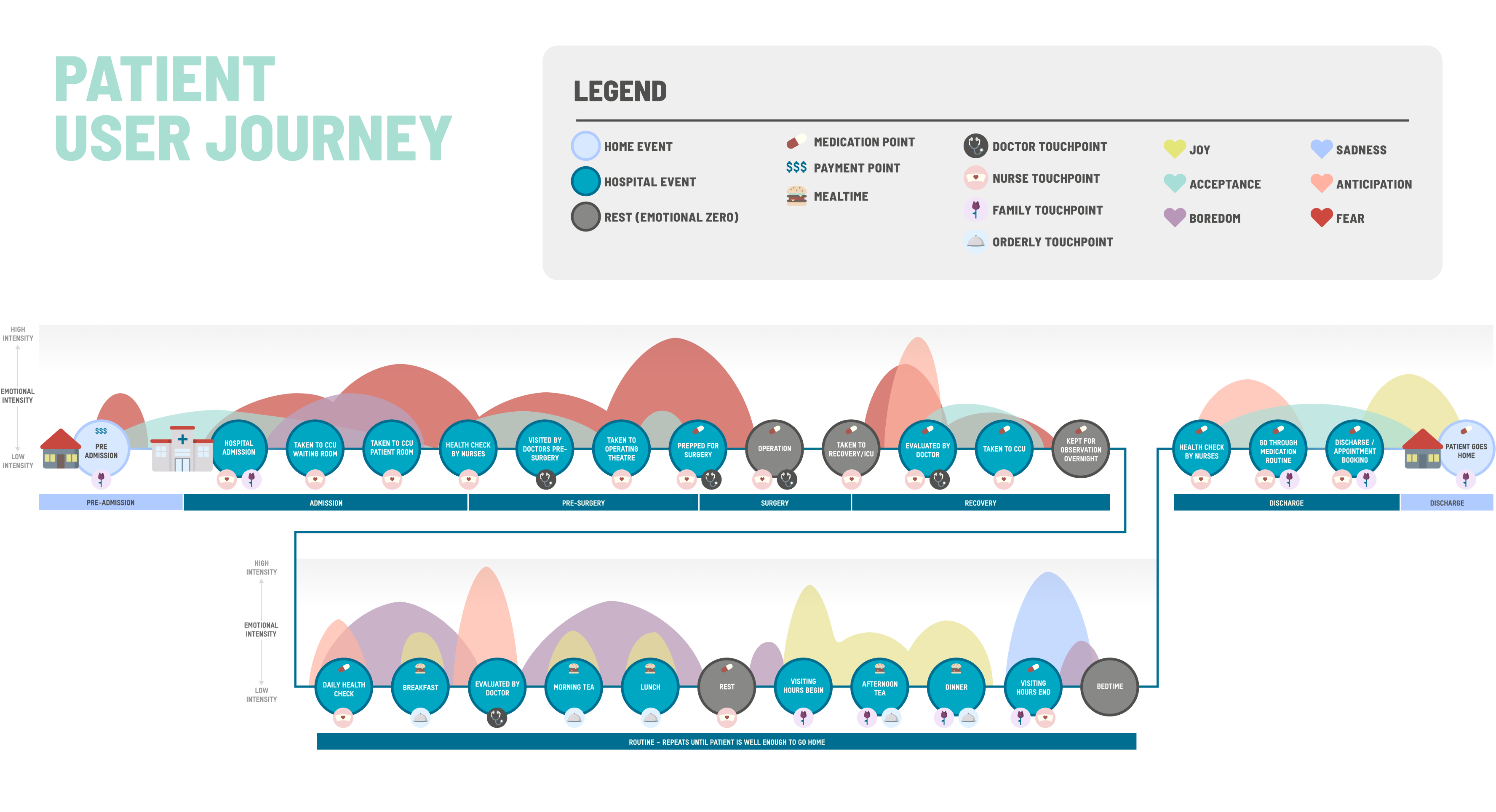
I explored the hospital environment, patient journeys, and the needs of potential users to understand how emotional well-being could be captured and acted upon in a clinical setting. Research methods included contextual inquiry, user interviews, comparative analysis, reviews of existing technologies, patient experience reports, and medical literature.
Research into established emotion frameworks, including the work of Robert Plutchik, Paul Ekman, and W. Gerrod Parrott, informed the selection and categorization of emotions within the proposed experience.
The research highlighted the complexity of emotional well-being during hospitalization. Patients' experiences could be influenced by their physical and mental health, medication, personal circumstances, and interactions with staff and visitors. Emotional needs could also change throughout treatment and recovery.
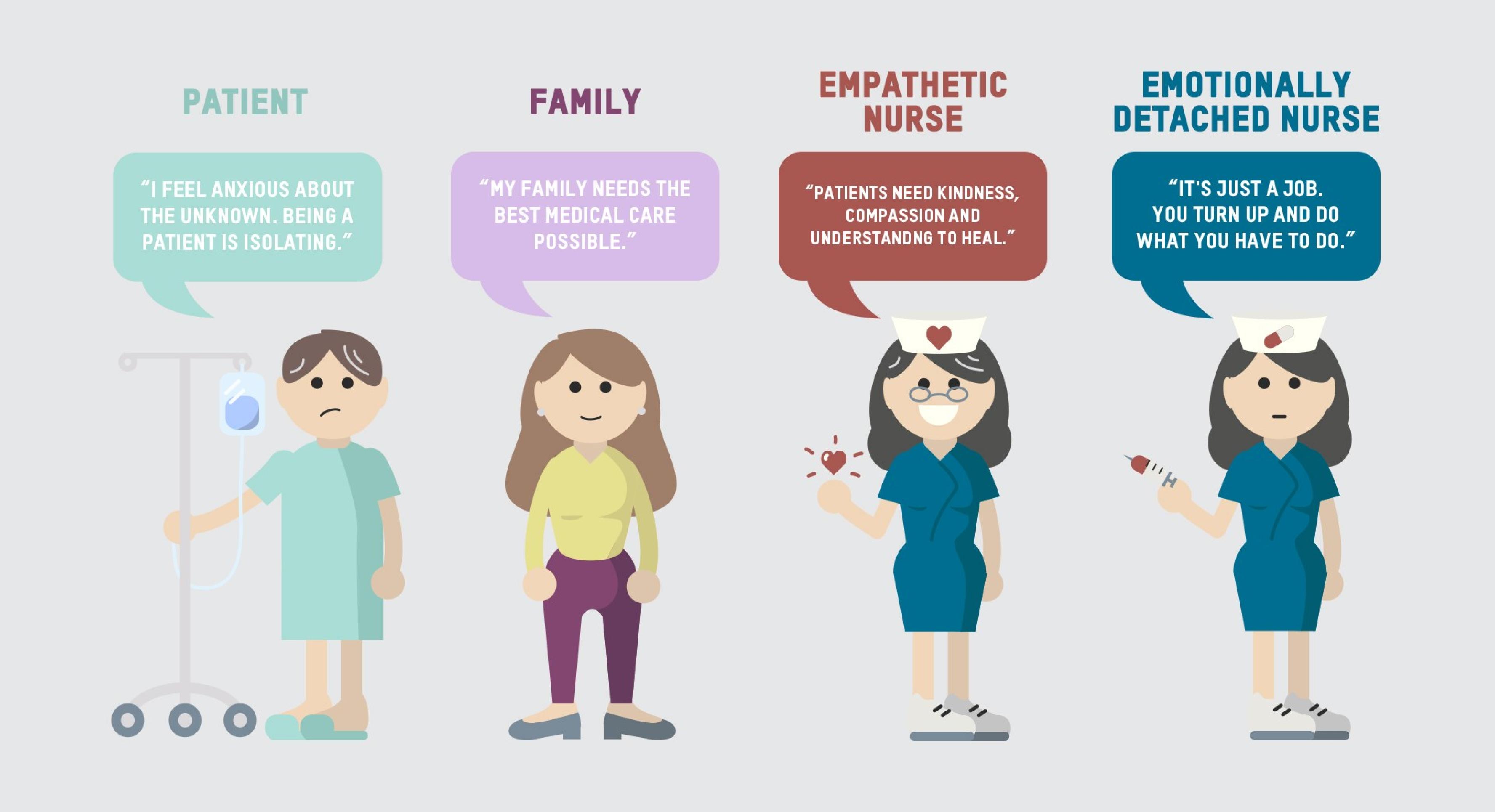
I mapped distinct patient journeys across day stays, overnight stays, and longer admissions, then refined the initial assumptions about the people who would use the product. This led to four personas representing key user groups, including patients and two types of nursing staff.
Long-stay patients emerged as the priority audience for the minimum viable product (MVP), offering opportunities to capture emotional experiences over a longer period and understand how those experiences changed throughout a hospital admission.
02.
the product.
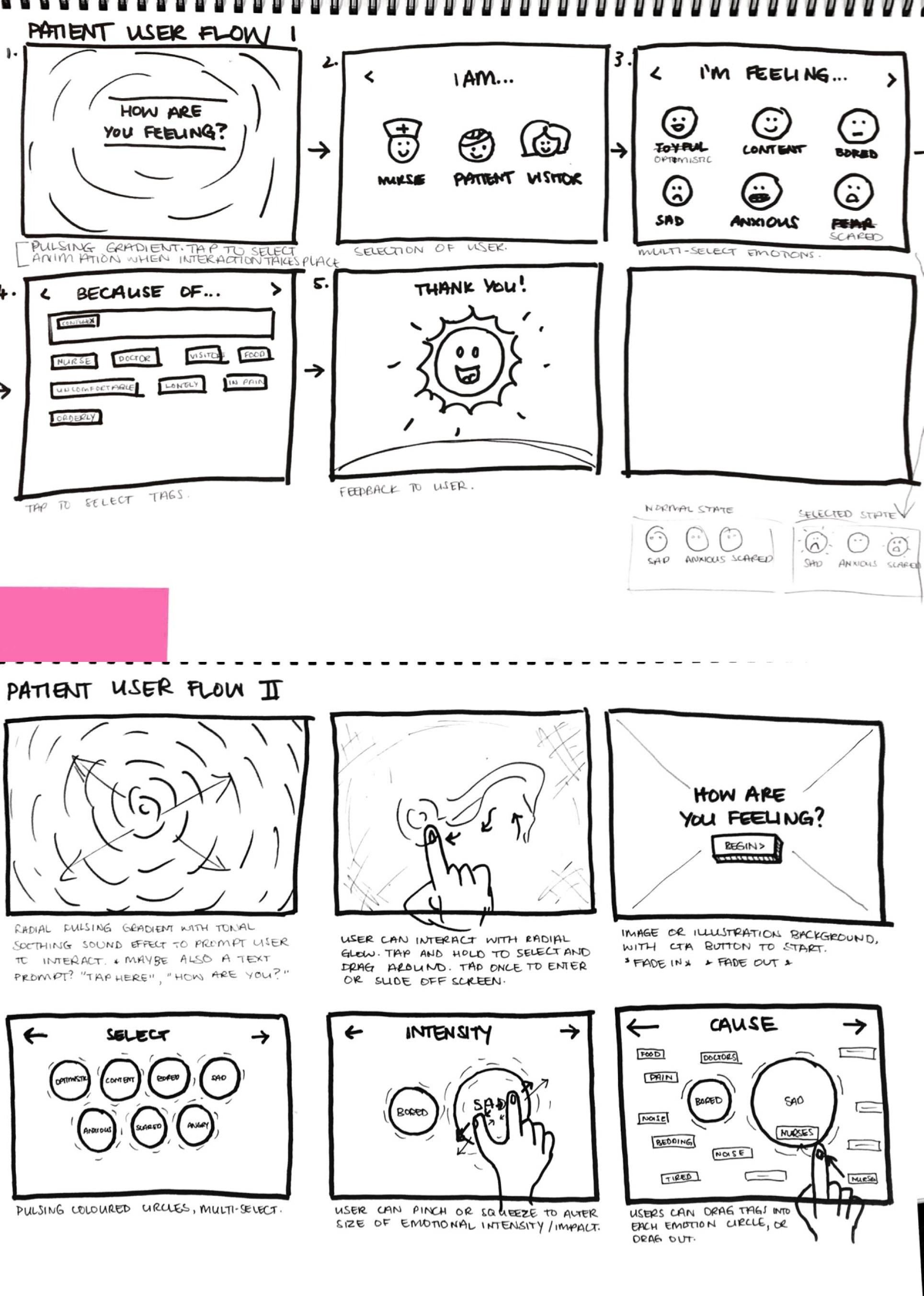
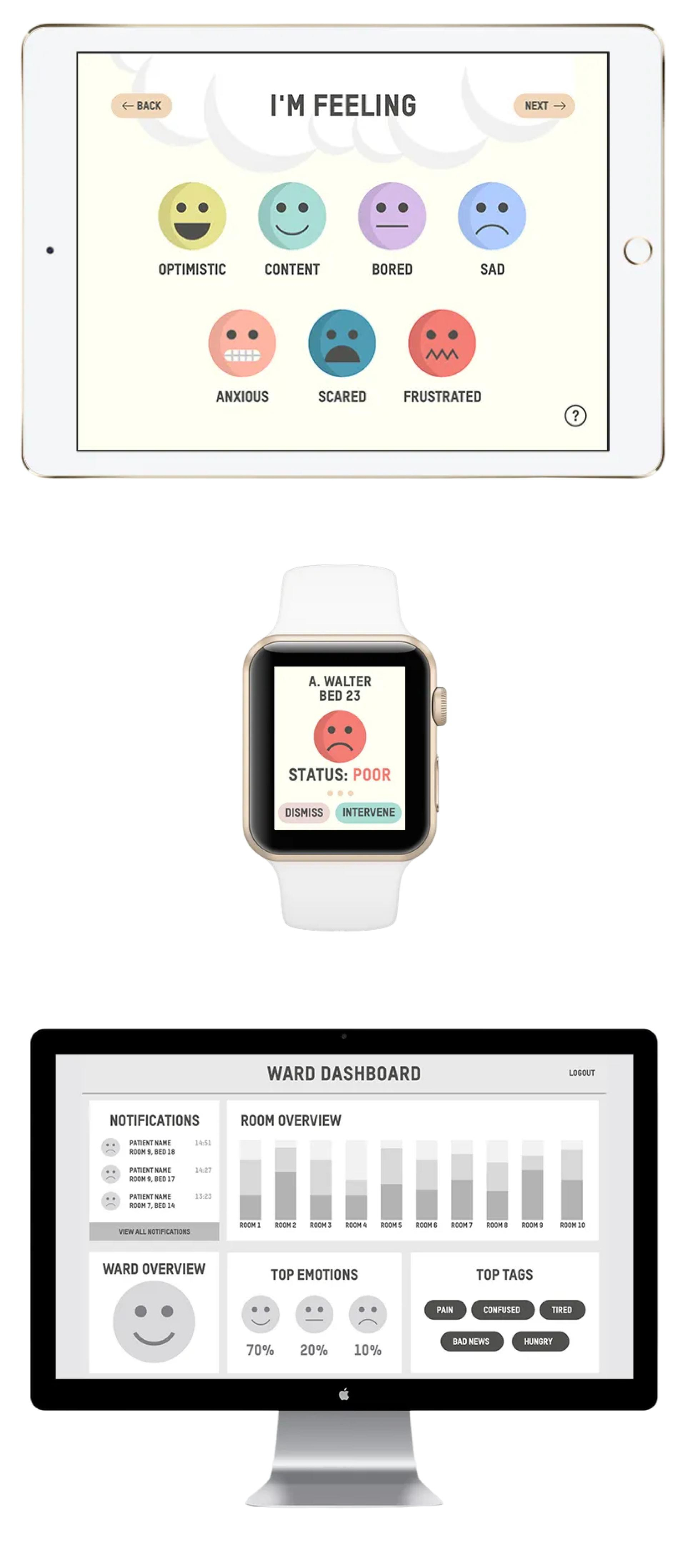
Following the research, I helped shape a connected product concept comprising three touchpoints: an iPad app for capturing emotional feedback, an Apple Watch for time-sensitive staff notifications, and a web dashboard for reviewing patient and ward-level insights.
The concept was tested through two initial approaches: an illustrative concept and an interactive prototype. All users involved in this round of testing preferred the illustrative concept. Further ideation and usability testing informed two additional iterations before the final proposal.
The resulting system was designed to bring together patient-reported emotions, contextual feedback from visitors and nurses, and an additional facial emotion recognition data source. Together, these inputs would provide healthcare teams with a broader view of patients' emotional experiences during their stay.
03.
the input.
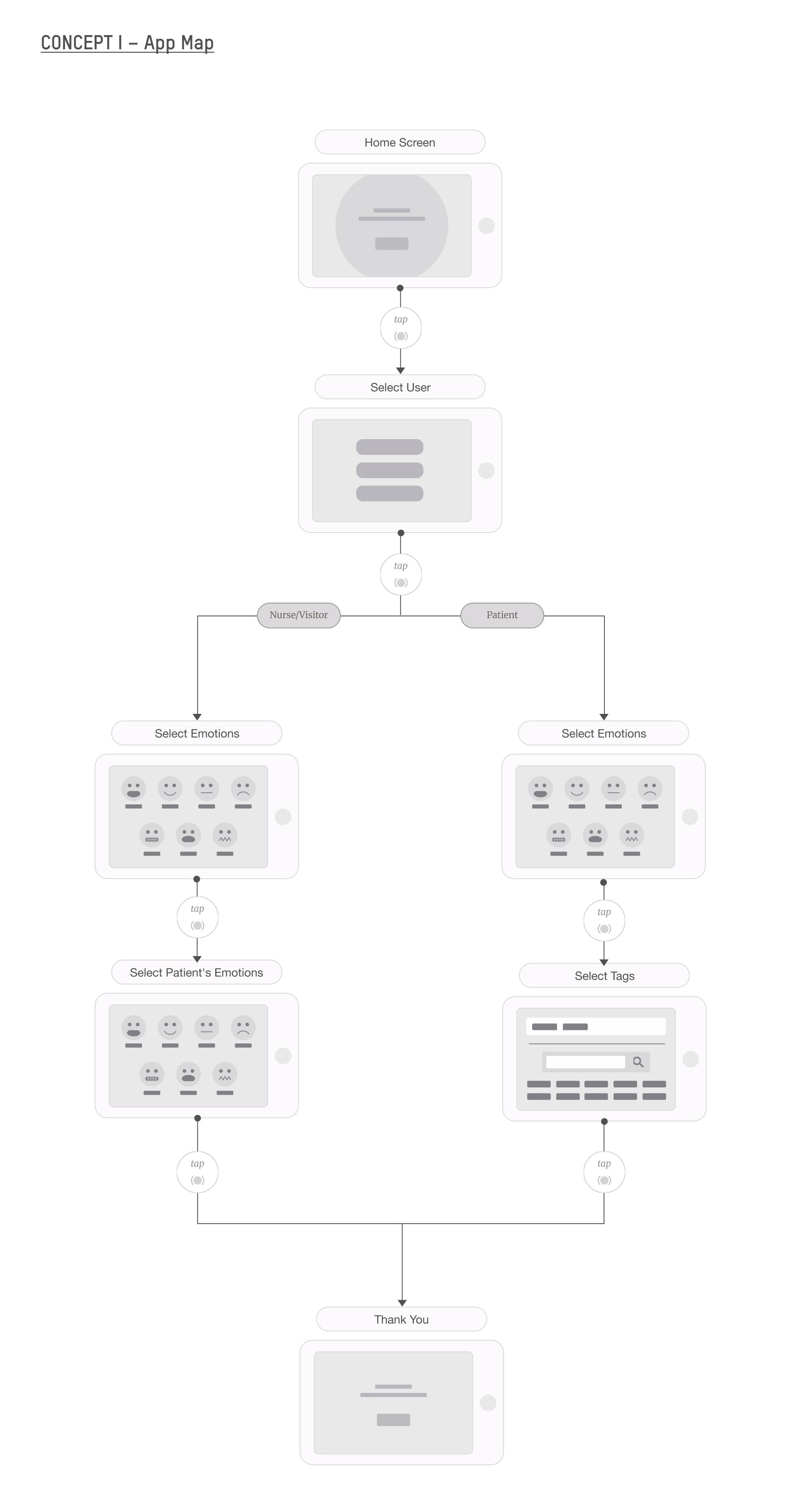
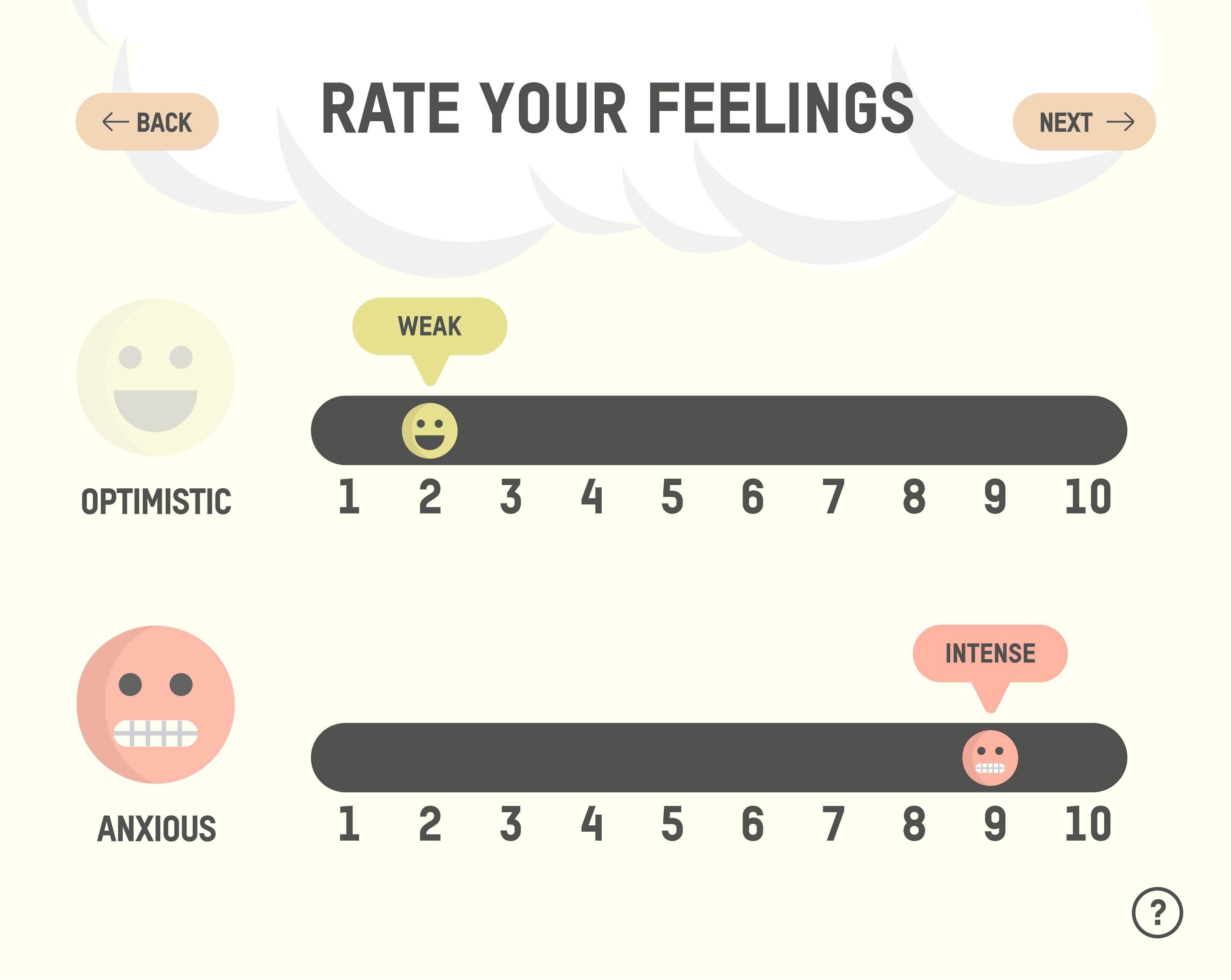
The iPad app was designed to make emotional feedback straightforward and expressive. Patients, visitors, and nurses could select multiple emotions, indicate their intensity, explain the reasons behind them, and add free-text comments.
For patients, the concept also incorporated facial emotion recognition as an additional source of information alongside self-reported feedback.
Combining emotional selections with intensity, context, and written comments was intended to give staff more than a simple positive or negative rating. It offered a way to understand what a patient was feeling and why, helping provide context for follow-up care.
04.
the output.
The proposed system translated incoming feedback into an overview of individual patient well-being and the broader emotional state of a ward.
An Apple Watch would notify the Nurse Unit Manager (NUM) when a patient's feedback indicated that attention might be needed. The web dashboard would provide nursing staff and ward clerks with an at-a-glance view of ward and patient status, while offering NUMs and hospital executives more detailed feedback, historical trends, and contextual comments.
A weighted scoring model would combine the different emotional inputs into three easily interpreted states: good, neutral, or poor. Specific comments or reasons that indicated a need for intervention could also trigger an alert.
Historical data was intended to help hospital teams explore patterns over time, including potential relationships between emotional well-being and readmission rates. The dashboard was designed to make these insights accessible to staff with different responsibilities, supporting both immediate follow-up and longer-term service improvement.
05.
the user interface.
The interface needed to feel approachable to patients while presenting information clearly to busy healthcare professionals.
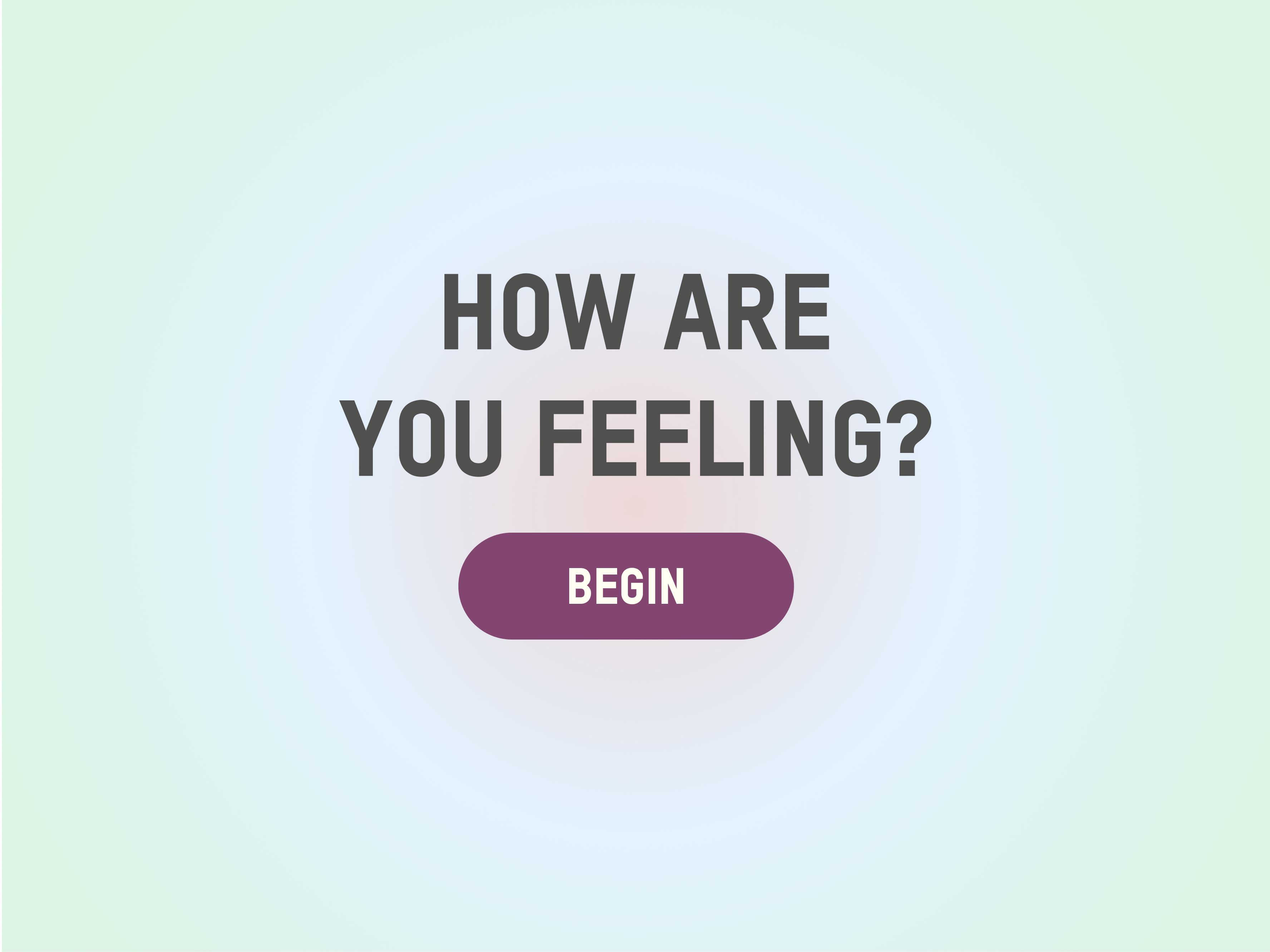
The visual direction drew on research into emotion and color psychology, using a soft pastel palette to create a calm, welcoming experience. T-Star PRO was selected for its clean, technical character, open letterforms, and legibility, with older patients in mind.
Across the proposed touchpoints, the design balanced an accessible patient-facing experience with clear, structured information for clinical staff. The aim was to make emotional feedback easier to provide, interpret, and act upon within the demands of a hospital environment.
patient experience app.

brand
medtronic
industry
healthcare
year
2017

Tigerspike (now Concentrix Catalyst) was commissioned by Medtronic to research and propose a digital product for monitoring patients' emotional well-being during hospital stays.
The concept aimed to give healthcare teams greater visibility into patients' experiences, enabling timely intervention when additional support was needed. By capturing emotional feedback throughout a hospital stay, the proposed system would also help identify patterns in patient experience and explore potential relationships with readmission rates.
As product designer, I shaped the research and product proposal, translating insights into a connected experience for patients, nursing staff, and hospital decision-makers.

01.
the research.
I explored the hospital environment, patient journeys, and the needs of potential users to understand how emotional well-being could be captured and acted upon in a clinical setting. Research methods included contextual inquiry, user interviews, comparative analysis, reviews of existing technologies, patient experience reports, and medical literature.
Research into established emotion frameworks, including the work of Robert Plutchik, Paul Ekman, and W. Gerrod Parrott, informed the selection and categorization of emotions within the proposed experience.
The research highlighted the complexity of emotional well-being during hospitalization. Patients' experiences could be influenced by their physical and mental health, medication, personal circumstances, and interactions with staff and visitors. Emotional needs could also change throughout treatment and recovery.
I mapped distinct patient journeys across day stays, overnight stays, and longer admissions, then refined the initial assumptions about the people who would use the product. This led to four personas representing key user groups, including patients and two types of nursing staff.
Long-stay patients emerged as the priority audience for the minimum viable product (MVP), offering opportunities to capture emotional experiences over a longer period and understand how those experiences changed throughout a hospital admission.
02.
the product.
Following the research, I helped shape a connected product concept comprising three touchpoints: an iPad app for capturing emotional feedback, an Apple Watch for time-sensitive staff notifications, and a web dashboard for reviewing patient and ward-level insights.
The concept was tested through two initial approaches: an illustrative concept and an interactive prototype. All users involved in this round of testing preferred the illustrative concept. Further ideation and usability testing informed two additional iterations before the final proposal.
The resulting system was designed to bring together patient-reported emotions, contextual feedback from visitors and nurses, and an additional facial emotion recognition data source. Together, these inputs would provide healthcare teams with a broader view of patients' emotional experiences during their stay.
03.
the input.
The iPad app was designed to make emotional feedback straightforward and expressive. Patients, visitors, and nurses could select multiple emotions, indicate their intensity, explain the reasons behind them, and add free-text comments.
For patients, the concept also incorporated facial emotion recognition as an additional source of information alongside self-reported feedback.
Combining emotional selections with intensity, context, and written comments was intended to give staff more than a simple positive or negative rating. It offered a way to understand what a patient was feeling and why, helping provide context for follow-up care.
04.
the output.
The proposed system translated incoming feedback into an overview of individual patient well-being and the broader emotional state of a ward.
An Apple Watch would notify the Nurse Unit Manager (NUM) when a patient's feedback indicated that attention might be needed. The web dashboard would provide nursing staff and ward clerks with an at-a-glance view of ward and patient status, while offering NUMs and hospital executives more detailed feedback, historical trends, and contextual comments.
A weighted scoring model would combine the different emotional inputs into three easily interpreted states: good, neutral, or poor. Specific comments or reasons that indicated a need for intervention could also trigger an alert.
Historical data was intended to help hospital teams explore patterns over time, including potential relationships between emotional well-being and readmission rates. The dashboard was designed to make these insights accessible to staff with different responsibilities, supporting both immediate follow-up and longer-term service improvement.
05.
the user interface.
The interface needed to feel approachable to patients while presenting information clearly to busy healthcare professionals.
The visual direction drew on research into emotion and color psychology, using a soft pastel palette to create a calm, welcoming experience. T-Star PRO was selected for its clean, technical character, open letterforms, and legibility, with older patients in mind.
Across the proposed touchpoints, the design balanced an accessible patient-facing experience with clear, structured information for clinical staff. The aim was to make emotional feedback easier to provide, interpret, and act upon within the demands of a hospital environment.